
Overview
The Episcopal Church has placed the care of God’s creation at the heart of its members’ common life. Members of Saint Philip’s Creation Care Commission give voice to this charge by offering a summary of resources available throughout Tucson, and by engaging in hands-on activities.
Contacts
Creation Care Chair
Greg Silva (gregsilva@aol.com)
Creation Care Vestry Liaison
Chuck Kirchner (chuck@chuckkirchner.com)
Creation Care Staff Liaison
Mike Italiano (mike.cheney@stphilipstucson.org)
Resources
Battery disposal
Batteries require special handling.
Suburban Miners (see Electronic Recycling below)
Interstate Batteries—provides information about what batteries it can recycle
Batteries Plus can recycle many types of batteries
Book recycling
Give your books a new life with someone else.
Friends of Tucson Library—books, audio, and visual items can be donated
Bookmans—Staff will decide what books, cds, dvds, lps, and games the store will take and give you cash or store credit.
Climate Action Now
Visit the website or download the app to learn about resources and ways to help fight climate change.
Clothing—good condition
Used clothing can be donated a number of ways.
If the clothes are still in good shape, you can take them to Green Monkey Boutique. If accepted, they will be sold on consignment.
You can also take them to Buffalo Exchange. If your clothes are accepted, you will receive either store credit (1/2 of the value for which the item is expected to sell) or cash (1/4 of the value the store expects to receive).
Each of these stores has its own rules, so they may or may not accept what you bring in.
If you simply want to donate clothes, you can take them to any Goodwill or Salvation Army donation center.
Clothing—worn out
Worn out clothes can also be taken to Goodwill or Salvation Army. If the clothes are deemed unsellable, they will be sent to recycling centers where they can be used to make other products like insulation, carpet padding, cleaning rags, etc.
Electronics recycling/disposal
Electronics contain materials that need special treatment so they shouldn’t be put in normal trash bins. Here are two local companies that will take your electronics and recycle what can be recycled and dispose of the rest in a responsible manner.
Suburban Miners—anything electronic, including batteries
Keeper of the Grumper—computer and electronics recycling, data destruction
Hefty Orange Bags
Many types of plastic can’t be recycled in the normal blue bin. But some of them can IF you use Hefty Orange Bags (and if you are willing to drive to one of the collection points around town). Go to https://www.hefty.com/hefty-renew to learn more.
Household Goods recycling
Do you have items around your house that you no longer want or need, but which still have life in them? Consider these options for passing them on to someone else.
Freecycle—create a profile, then list the items you want to get rid of for free.
Habistore — Habitat for Humanity offers this resource so you can donate household items that can be resold to others doing home repairs and renovations. Profits help support the work of Habitat for Humanity.
Household Hazardous Waste
Learn where a collection event will be held near you by clicking here.
Medical Waste Disposal
Visit the Tucson Environmental Services site for information about proper disposal of medical waste, including unused drugs and sharps. .
Recycle Coach
This smartphone app can generate reminders for all trash and recycling pickups at your address, alert you to upcoming special pickups like Brush & Bulky or a nearby Household Hazardous Waste collection. You can also learn how to properly dispose of specific items.
Go to www.recyclecoach.com or download from AppStore/Play Store
Adopt-A-Road
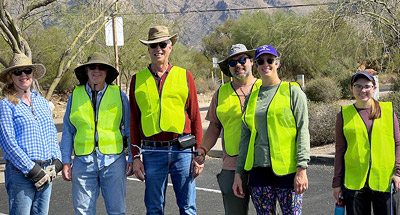
Saint Philip’s is the proud sponsor of the mile-long section of Campbell Avenue north of Skyline Drive. Volunteers (14 years and older) clean the road of litter twice a year. They wear fancy safety vests and are given bags and extended grabber tools to collect any litter. After their work, they gather for lunch and fellowship.
Contact Greg Silva (gregsilva@aol.com).
The natural world
Saint Philip’s is delighted to be part of Tucson Audubon’s Habitat at Home Program.
Volunteers created a pollinator garden at the entrance to the church office. It is watered by rainfall and has plantings that attract pollinators.
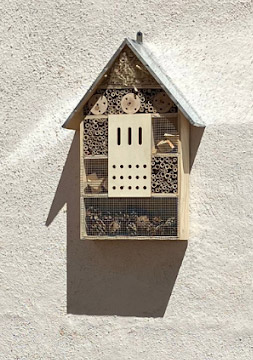
Solitary bees (which are non-aggressive and responsible for 1/3rd of all food humans eat) live in the ground in the labyrinth area. They also have a lovely house they visit in the pollinator garden.
In 2023, the youth built nesting boxes to attract different birds. They now host families, including a vermillion flycatchers with babies and at least one Lucy’s Warbler.
In 2025, children who attend Vacation Bible School worked with Saint Philip’s woodshop volunteers to build four owl houses and four more solitary bee houses. These have been placed around the campus. Once owls move in, they will help keep the pack rat (and other small animal) populations under control.
Great Window Nature Area
In 2025, volunteers from the Creation Care Commission, the Garden Guild, and others (including family members and even a certified Arborist) worked to improve the Great Window Nature Area—the land between the Great Window at the north end of the sanctuary and the north parking lot.
They created four basins and accompanying channels to collect rain water off the west side of the music center and sacristy and the north side of the sanctuary. These basins retain the water so it can be used by plants and animals in the area. The basins also prevent water from collecting against the building on the north side of the Great Window.
Volunteers also began laying paving stones throughout the area to create a path for better access so the area can be enjoyed.
Following the basins’ creation, a few good rain storms confirmed they worked as envisioned. Desert revegetation seed mix has been scattered in the area to make it even more attractive (and to prevent erosion). A very big thank you to Tucson Cactus and Succulent Society which donated six ocotillos to Saint Philip’s for this area.
2026 plans include planting new trees, cacti, and other plants, completing the walking path, and continuing to generally improve the area. As these projects are scheduled, announcements will be placed in the weekly e-newsletter Bell & Tower so anyone interested in helping can join the fun.
Outreach
In the spring of 2024, Saint Philip’s Grant Writing Committee submitted an application to support local eco-ministry efforts. $12,000.00 was approved by a committee of the churchwide Task Force on the Care of Creation and Environmental Racism. The grant funded a project at Prince Elementary School* in the Amphi neighborhood (which has been identified as an “urban heat island.”) Historically, minority, low-income communities have much less vegetation and consequently higher heat levels than wealthier neighborhoods.
Members of the Creation Care Committee partnered with the Outreach Commission, the Adult Formation Commission (through the Anti-Racism Discussion Group), and CYFM families and children.
The grant provided funding to retain a local nonprofit, Watershed Management Group, to deliver educational modules to Prince students, train volunteer families from Prince and Saint Philip’s, and develop a planting design based on student and teacher feedback.
On Saturday, November 2, 2024, Watershed oversaw volunteers install a rain garden, a cactus garden, and a bosque of trees. These plantings are now thriving, attracting pollinators, conserving water, and providing shade. This will continue for years to come.
*Prince Elementary School is one of the most ethnically and racially diverse schools in the Amphitheater School District:
- More than 17 languages are spoken.
- It serves an economically disadvantaged, “at environmental risk” population with 100% of students enrolled in the federally subsidized lunch program.
- The school scores in the lowest 30% in math and reading performance among elementary schools in Arizona.
Historically, minority, low-income communities have many fewer trees and consequently higher heat levels than wealthier neighborhoods. Prince Elementary School is in one such community and this grant will help increase shade, add rainwater infiltration, and produce vegetation that will lower temperatures and affect the neighborhood positively.