
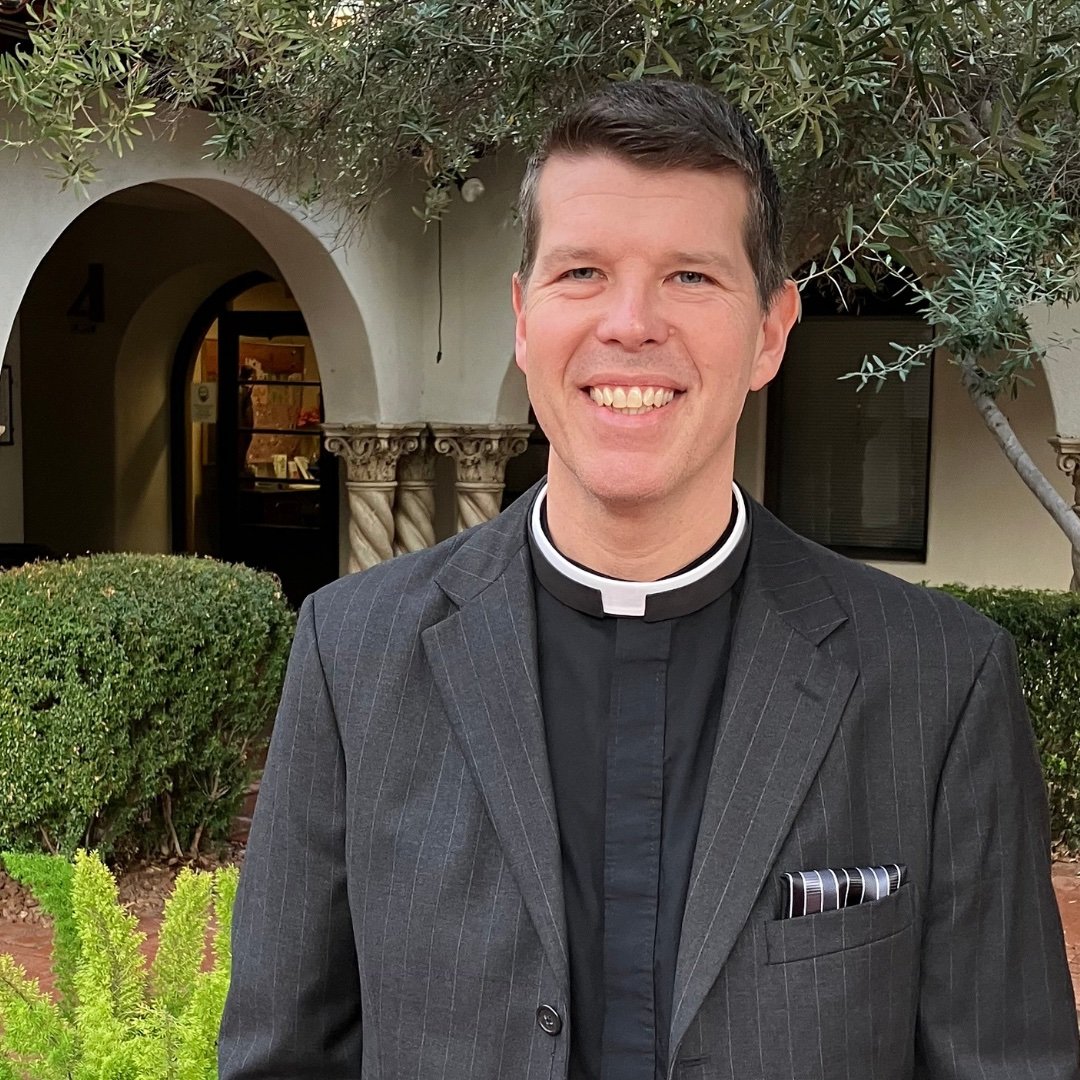
From the Rector
Dear Friends in Christ,
“The Episcopal Church is a church where you can come in without leaving your brain at the door and then have the opportunity to love all of those who managed to come in with their “wrong ideas.” — The Rt Rev’d Leo Frade, Bishop of the Diocese of Southeast Florida
“We deeply love the intellectual as well as the spiritual life that is cultivated in our members (‘you don’t need to leave your mind at the door’)” – Progress Report from the Task Force for Re-Imagining the Church
Recently, I saw these quotes pop up in two different places. As I read the report from the Task Force, I found myself thinking, “Is this what we want a reimagined Church to emphasize?”
I get what people are saying when this line is put out there. Many of us come from traditions that were overly dogmatic, prescriptive, or even fundamentalist. Yet I find there to be a sad smugness to our adopting this line as a party platform.
I have chosen this Church over the Roman Church and yet I do not want my Roman Catholic family members and friends to think I chose this Church because they are all leaving their brain at the door when they go to Church.
What does this kind of message say to a single mother who goes to the local Baptist Church because they invite her and her kids to sing in the choir and to be part of the Singing Christmas Tree? What does it say to the widow who goes to the local Roman Church because it was the last place she felt real peace? What does it say to the Methodist dentist who goes there because his family has for four generations and they built the church steeple?
The Episcopal Church has enough issues with people perceiving us as a club that is not for them. Why would we perpetuate that perceived haughtiness by adding yet another perceived barrier—a lack of smarts—to coming to our churches?
As we were undertaking mission work in New Haven, one of our challenges was that there were many with whom we were in ministry who couldn’t read English—or couldn’t read at all. I don’t want them to ever think that the Episcopal Church is not a place that they could call home because they weren’t smart enough.
If the Episcopal Church wants to put up signs that say “All are Welcome” then we need to be prepared for all kinds of people to come through our doors—people who aren’t there to prove that they are smarter than other faithful people.
I wonder what exactly qualifies as checking one’s brain at the door? If one believes in the Virgin Birth, the bodily Resurrection, the Second Coming, miraculous healings, and the efficacy of relics—has one checked one’s brain? If one both rejects the death penalty and abortion—has one checked one’s brain at the door? If one believes that God, indeed, has sent angels to watch over us—has one checked his or her brain at the door?
Much of our culture already thinks that we have checked our brain at the door simply for believing at all.
I have met clergy with shocking gaps in their theological, liturgical, and organizational training. My own gaps in Scripture, contemporary theology, and modern music are sources of real stress at times in my dialogue and teaching. In other words, even our seminary trained ministers have lots of learning to do—especially when I talk with Methodists about preaching, Roman Catholics about social doctrine, Baptists about Scripture, and Pentecostals about the power of the Spirit.
Comprehensiveness as a Church must mean that we are open to learning from brothers and sisters of the faith rather than dismissing them as insufficiently smart or lacking in self-awareness. It is unhelpful for us to position ourselves as the Church that isn’t full of unthinking spiritual drones when there are faithful, kind, and generous people across all Christian traditions.
I recognize that we have methodological differences in interpretation of Scripture and hierarchical differences with regard to authority from other churches—and that these differences have hurt many. Yet every other church out there is not some version or another of Westboro Baptist or the like.
Frankly, we’re just not that smart and we have much to learn from many. And thankfully Jesus doesn’t seem to be searching out smart people to share his message. He looked for those who were least likely to be “in” or even thought of as people—let alone who might be smart. Jesus calls us to the deepest love for one another and a charity of spirit that this kind of language undermines.
I pray that we’ll be careful talking about checking brains at the door lest people think we’ve decided to check our hearts instead.
Yours in Christ,
—Fr Robert


Excellent message. The points you make are on the mark. One point you probably did not intend to make but successfully did is that of clergy formation. My jurisdiction is small, mostly located in Central and South America. I come to your church on Sunday because you are here and my jurisdiction has no church in the area – yet. Three of the priests I oversee are former Roman Catholics. I make the point over and over again on the requirement that formation begins before receiving the tonsure and may possibly end only three days into the grave. Formation is also comprehensive. There is always more to learn. We need well informed priests as well as well informed lay members. Thank you.
Bishop Paul Breton
This is a needed reminder that we do often look as though we are superior. Remember those horrible lists of “Why I am an Episcopalian” that were probably meant to be funny but came across as smug superiority. There are plenty gracing our congregations who voted for and still support Donald Trump, a very sure sign that one has heard almost nothing of the core of the Gospel or let their fears become central to their practice of discipleship. It is also an indication that we have done a very poor job teaching that “the Word was made flesh” and not some super spiritualized version of nice things for nice people
Thank you for this message. I have belonged to St. Philips for many years. My children (now middle-aged) were acolytes. The only problem for me is, I sometimes can’t understand the people who go there. They are so educated, they speak a different language. I was beginning to think I don’t belong. Thank you for seeing this. I don’t mean anyone is unkind or looks down on me (I hope not). It just seems this church seems to attract super educated people.