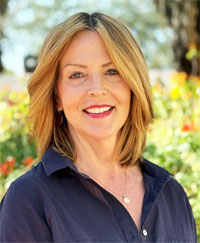
Kiki Cheney
How long have you worked at Saint Philip’s?
Since February, 2019.
What’s your role at Saint Philip’s?
I worked as the part-time Communications Associate until November 2024. I’ve now moved into the full-time role of Parish Administrator.
Were you raised in a faith tradition?
My family was Roman Catholic. I attended parochial school from 1-12, including an all-girls Catholic high school.
How did you find your way to the Episcopal Church?
My mother died from breast cancer when she was only 40 years old—and I was 14. The Catholic parish where she’d been active pretty much abandoned her during her year at home.
Fortunately, neighbors who helped our family were members of the Episcopal parish just down the street. The rector visited regularly and was a beautiful ambassador for the Episcopal church.
When I attended Sunday service for the first time I was hooked immediately by the majesty and elegance of the liturgy. And discovering the Book of Common Prayer was like finding a treasure chest.
What did you learn from your mother’s death?
So incredibly much. She modeled grace throughout her illness and showed me how to die with dignity. Nurses stopped me on the street years later to tell me they still talked about her courage.
My father taught me how to step up when faced with something devastating and overwhelming. He was out of his mind with fear but he kept it together for my younger brother and me. He learned how to cook and clean so I could remain the daughter and not the ersatz wife.
I learned that some days—and weeks and months—might be ugly and messy but I can survive my worst days.
Is there a decision you made that had a real impact on your life?
Absolutely. I often say the luckiest thing that ever happened was that my husband asked me out. The smartest thing I ever did was say yes.
My life is bigger, fuller, and better than I could have ever imagined. And it’s all because of knowing and being with him.
What’s one of your guiding principles?
No effort is ever wasted.
I may not see the results right away but my experience is that if I do my best, and give my best effort on the front end, it inevitably yields a result. That could be anything from knowledge or experience to a tangible outcome. But whatever the result, it’s almost secondary to the benefit of exercising discipline and focus.
What’s something you’re proud of?
I haven’t thought of being proud of this before but I’ll say my commitment to connect and include people.
It’s amazing how childhood experiences stay with us. I had a real hard time navigating the social aspects of school. Even now I can feel what it was like to stand on the sidelines at recess because I wasn’t invited to play.
I remember making a conscious choice as a young adult to do my best to include others. I did that even though my wounded self often wanted to lash out. But my desire not to inflict that same hurt helped move me forward.
What’s something you’re grateful for?
My parents and my husband. I regularly marvel at my good fortune. There are so many people who need and deserve support; I am no more deserving than anyone else. Yet I was lucky to be born in this country and into a family that wanted me and loved me.
And even more than that, my parents and spouse have supported all my dreams—no matter how outrageous. I’m blessed that I’ve always been encouraged not to follow the herd and, instead, to trust my instincts.
What did you do before working at Saint Philip’s?
So many things! I lived in New York City for 20 years and worked in a variety of fields. I never pursued a specific career but the common thread throughout all my jobs was service; I like to help people.
In my twenties, I was a professional waitress, traveled to ski resorts around the country with a marketing firm (and had real motorcycle bikers as my crew), and was an assistant buyer for haute couture at Henri Bendel.
Around 1997 I started working at the Episcopal Church Foundation where I helped manage the national church’s planned giving program. That ultimately led to my decision to attend law school at 37. I practiced for a few years after graduation but decided it wasn’t for me.
My husband and I moved to Tucson in 2010 and I was able to switch gears and do administrative work—which is a much better fit.
What’s something you’re passionate about?
Turn signals! Well, turn signals are an example of one of my core values which is community.
Can you explain that?
We’re all in this together. So when someone doesn’t use a turn signal it feels like a blatant disregard of how one person’s actions impacts those around them. It can be really hard to live in community so I value the “guardrails” that help make it possible. And turn signals are one of those guardrails.
I recognize my reaction is disproportionate to the actual event. But still…!
What’s something you know now that your younger self didn’t?
It’s ok to be vulnerable and ask for help. Learning that transformed my life. It’s deepened relationships, and made me more pleasant to be around.
What might people be surprised to learn about you?
That German was my first language. (My mother was born and raised in Germany and met my father when he studied at the University of Heidelberg.) And that I’m in the process of obtaining German citizenship.
Oh! I also keep my motorcycle license up to date.
What’s something you find challenging?
My husband would say domestic tasks like cleaning! I’ll say that I find it challenging to remember that my energy isn’t unlimited.
When something engages me I like to jump in and embrace all of it. Getting older has taught me that the “well” needs to be replenished. But I still have to be intentional about that.
What have I not asked that you would like people to know?
How incredibly fortunate I feel to work at Saint Philip’s.
The people who make up this community are passionate, dedicated, smart, and incredibly generous. And my colleagues are top notch. We help each other and pitch in as needed. There’s also a lot of laughter—which feeds my soul.
What’s a fun fact about you?
I got kicked out of Prague.
Wait. What?
I was living in Germany earning my degree in Hotel Management. During a break from school I planned a weekend trip to visit a family friend in Prague. This was back when Czechoslovakia was still part of the Soviet Union.
I was required to exchange a certain amount of money for each day of my Visa. That was a big deal because I was a poor apprentice and every Deutsche Mark was valuable.
The visit was so lovely that my host invited me to extend my stay. I went to the police station to do that and was told I had to exchange additional money—which I then did. I returned with the cash but was refused the Visa.
I was in my early twenties. My youth and an American expectation of law and order kicked in, and I challenged the officers. I can still see their incredulous expressions. And then they got angry at my audacity.
They escorted me to my host’s apartment, and watched while I packed my bag and scribbled a note to my host. They then escorted me to the station and waited on the platform while I sat in the train car.
When the train finally pulled away I remember wanting to be snarky and wave at them. Thankfully, good sense calmed my lizard brain and I sat on my hands—and recognized I was lucky to be leaving a communist country without issue.