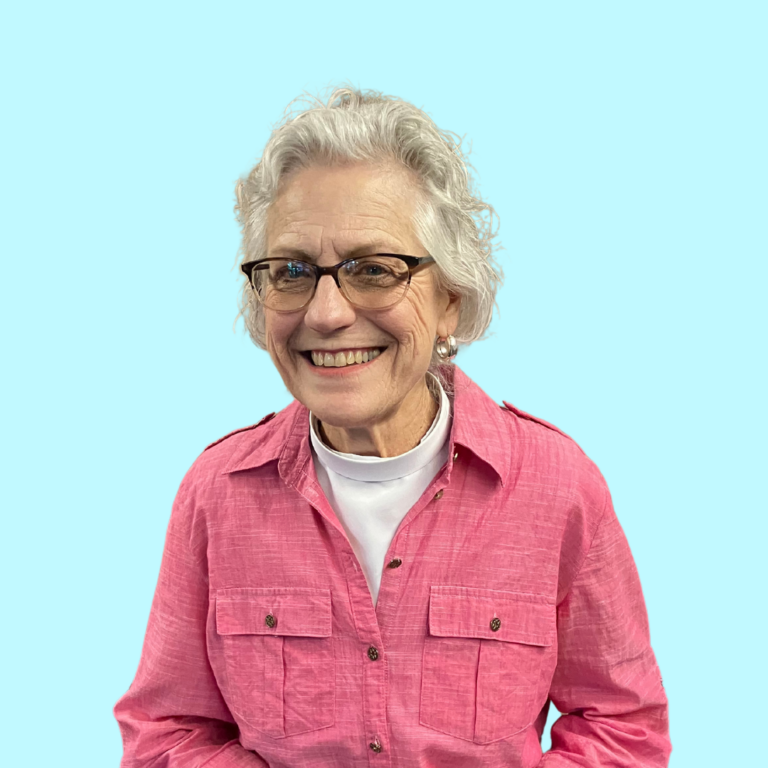
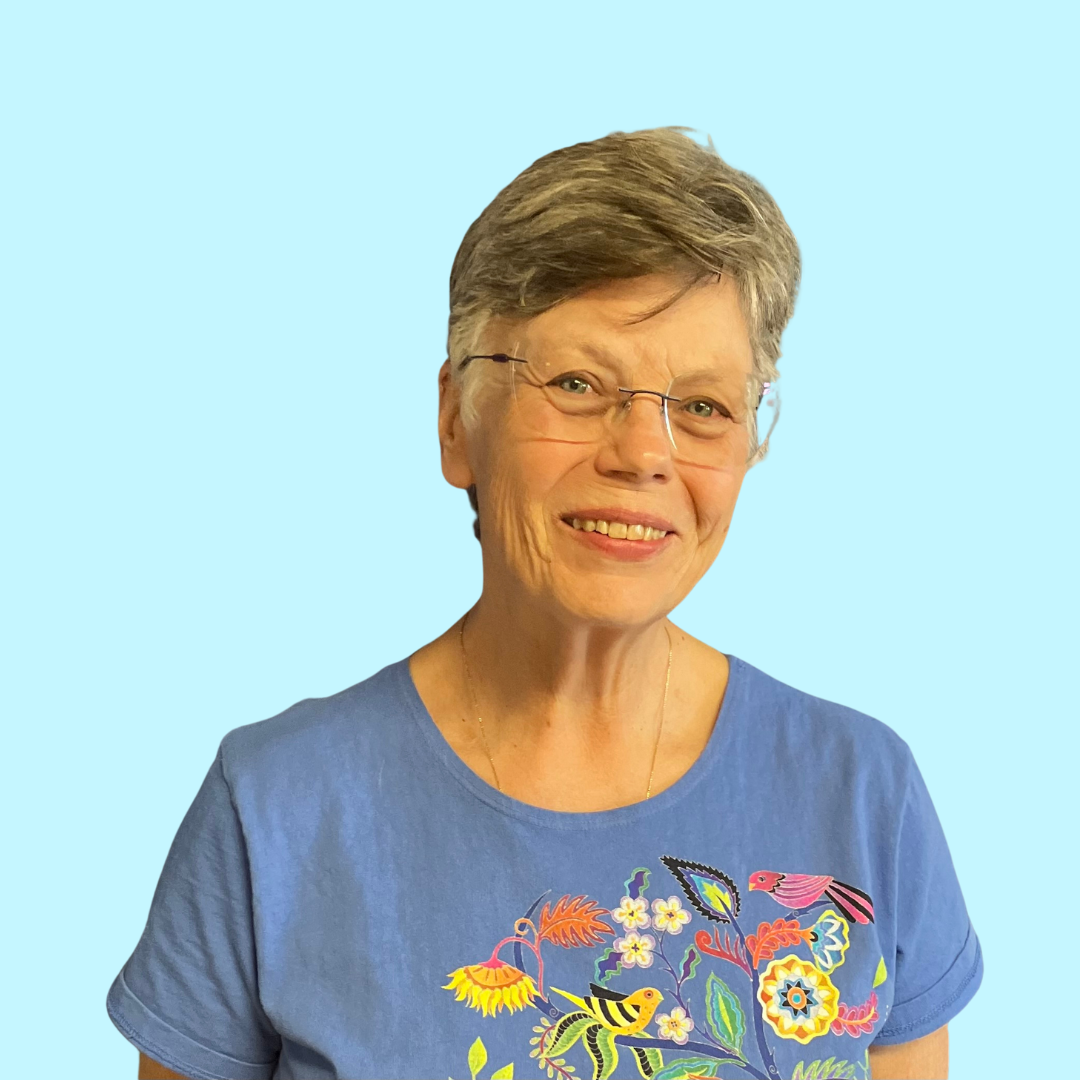
Margaret Babcock
How long have you worshipped at Saint Philip’s?
Since 2022.
Were you raised in a faith tradition?
I was raised in the Episcopal church. My father was a Lutheran, but he became an Episcopalian when he married my mother. We always went to church; it was a big part of our lives.
Did you leave church as a young adult?
I know that’s a common occurrence, but my way of rebelling was to decide to become a priest. I wanted to dive deeper into the tradition rather than away from it.
I’m 71 years old so my decision was before the church ordained women as deacons, much less priests.
How did your bishop react?
Bishop Walter Righter (Diocese of Iowa) turned out to be very liberal. He said I could attend seminary, but he didn’t know what would happen. He asked me why I wanted to be ordained, and I told him that I really like people and in the church is where I think they are most interesting. The usual answer he got was that the candidate liked liturgy, so he appreciated my perspective.
Your path to ordination wasn’t a straight line, though. Is that right?
That’s right. I attended Seabury-Western in Evanston, Illinois for two quarters but quit when I got married. That was in 1974 when the vitriol and misogyny of opponents to women’s ordination was at its height. I felt called to marry Chuck and that trumped dealing with the hatred.
We returned to Minnesota, and I began a master’s degree in community counseling. But then the 1976 General Convention happened.
How did that affect you?
Very personally. My mother was a deputy, so I stayed in her room during the proceedings, which included the vote that approved women’s ordination. I remember finding my mother afterward and embracing her. I returned home and told Chuck that I had to return to seminary.
I finished my counseling degree first and then returned to Seabury where I graduated in 1980. The counseling degree helped enormously because there wasn’t much focus on that in seminary.
How are you involved in the parish?
I’m part of the Pastoral Care team, and I recently began contributing a monthly reflection for Daily Bread.
What marked your professional career?
There were quite a few “firsts.” Two notable ones were that I was the first woman priest to serve in the Diocese of Arizona (1981) and the first woman rector in Arizona (at St. Matthew’s, 1990-2000).
After serving as Canon for Congregational Development in Idaho and Wyoming, I started a coaching and consulting business and did that for seven years. Whether I was self-employed, serving a church, or working on a diocesan staff, my focus was almost always on small churches.
The question was generally, “How does the church go into the future with these very small communities?” We’re not called to grow big churches. Jesus calls us to be faithful.
Saint Philip’s is not a small parish so what attracts and keeps you here?
I never ever thought I would end up here, but life happened.
My husband, Chuck, and I returned to Tucson in 2022 to support my mother, Peg Anderson. She was a pillar of Saint Philip’s; this parish was a big part of her life prior to the pandemic. She was able to participate in this community until her health failed.
Chuck and I discovered that we love to sit in the back of the church and listen to the choir. The music here has been an unexpected gift that we’re really enjoying. And while Saint Philip’s is a different experience, we feel called to stay here. I’m not sure why but I definitely feel called. I’ll unpack that as time passes.
My experience is that calls are often very surprising, and this is no different.
What’s one of your guiding principles?
At this point in my life, I have a deep belief that love will win over everything. I think I’ve always felt that way but I’m more willing at this age to trust the long arc of history. I also believe that love draws that long, long arc and that’s what saves our faithfulness in the end.
What might people be surprised to learn about you?
That I’m a published author. My first two books were about congregational development.
More recently, I’ve written two science fiction novels. The second novel just came out and I’ll do a book reading and signing in the Little Shop on Sunday, December 15, after the 10 o’clock service.
What’s your genre?
Mysticism meets science fiction. I’ve always loved science fiction because it invites the reader to leave the known behind and take a look at what life could be. That’s always fascinated me.
What’s the theme of your second novel?
First, I have to say that I don’t write from the perspective of proselytizing. In my first book, I explored what might happen if you took a bunch of faithful people of various traditions (including scientists) out of their culture and sent them on a dangerous journey to a different planet. What would happen?
My second novel dives further into the evolution of a new culture and how a relationship with the planet affects humanity and faith. There’s more information at www.margaretbabock.com–or come to the book signing on Sunday, December 15!
What’s something you find challenging?
It’s very difficult for me when people are judgmental—about me or others. It’s especially challenging when that judgment shuts down communication.
Judgment without curiosity to learn more, investigate further, talk more…that’s a kind of violence.
How do you deal with that?
I’ve worked really hard to try to learn Non-Violent Communication. It’s a discipline that Marshall Rosenberg began. He taught how to speak to one another so that we invite connection rather than judgment.
M. Scott Peck developed a parallel idea that identified different levels of conversation. Most of us stay at the top, superficial, level where it’s easy not to identify differences. As we go deeper into conversation, though, differences are revealed. It’s at this point where we have a choice: we can bounce back to the superficial and distance ourselves or we can engage in a way that allows for a deeper connection. Rosenberg taught how to make those deeper connections.
What’s one tool that people reading this can try to implement?
Be curious. There are universal human needs, but different strategies for getting them met. When talking to someone be curious about what need they are trying to meet.
It’s easy to focus on how someone tries to meet a need (the strategy) instead of the underlying need. Be curious about why someone feels the way they do.
It’s hard but practice builds that muscle and, in my experience, is well worth the effort.
What’s something you’re passionate about?
I’m passionate about prayer and meditation. That practice gives me focus and anchors my life.
I’m passionate about that because it’s crucial to my well-being and relationship with God. And while the basic rhythm has been there for years, I still tweak it regularly. I’ll try different styles of prayer and read different things.
What’s something you know now that your younger self didn’t?
I’ve learned that the world isn’t fair and that’s ok. That’s been a hard, hard lesson.
What helps you accept that it’s ok the world isn’t fair?
Understanding that grace doesn’t depend on fairness. And that then gets me back to the belief that love is that long, long arc and connection with grace is much more important than connection with fairness.
You can be right about something but not insist on it. It’s that insistence on rightness that gets us out of relationship with each other.
What’s one of your core values?
It’s important to me to be patient enough to listen to what’s being said. I’m still trying to grow into that—not only with other people but with God, too. And myself. I try to ask myself what’s going on inside me as I listen to others.
That’s helpful because when I don’t know what to do, I’ve found that sitting with the not knowing allows the next step to reveal itself.
What’s something you’re grateful for?
My family. I’m so fortunate to have a partner in life who is supportive, and is as open and loving as Chuck is.
I’m also grateful that we have this time with my mother, and that my siblings have come out and spelled us. As a counselor, I know the kinds of difficulties families get into with these types of situations, and we’ve been blessed to have support and care.
Do you have a bucket list?
I’m at a crossroads—a waiting place. Having finished my second book, I now need to decide if I’ll write another one or if I’ll stick with short stories. I’m sure I’ll keep writing but it might be time to do something else as well to expand my horizon.
What might that “something else” be?
I would love to be able to draw. And not just to create an image but to learn how to perceive things as an artist. I’d love to try that.
What’s a fun fact about you?
A real formative experience in my life was that we lived in Germany when I was in grades 6 and 7. My father worked for John Deere and he was sent to Mannheim to help design tractors.
We lived in such a small apartment that my parents slept on the couch for two years. We went to the American military base for school but it still felt foreign because the military culture was so unknown.
We traveled all over. My mother was determined to make the most of every second we were in Germany so we drove all over the continent!