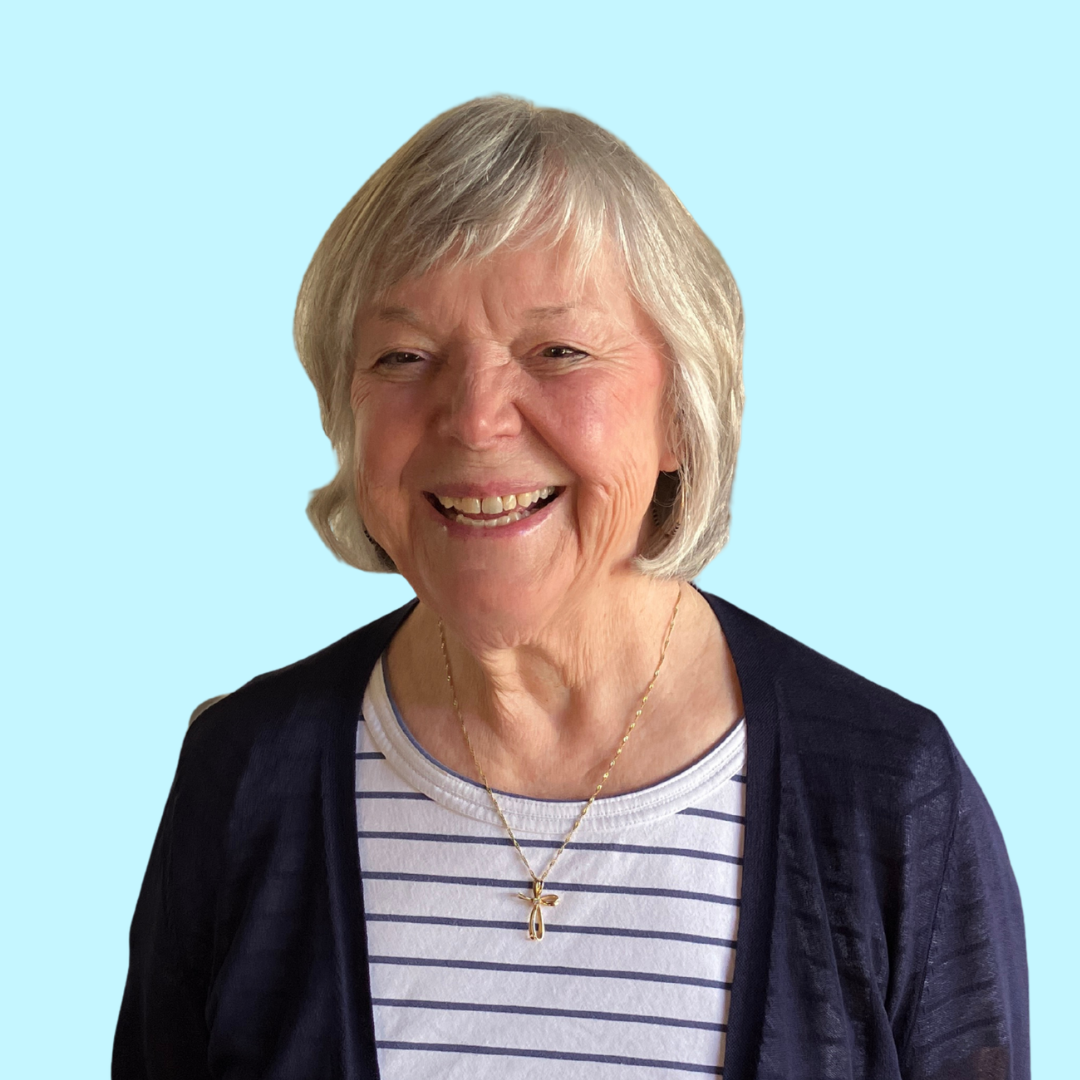
Jan Slaby
How long have you worshiped at Saint Philip’s?
Most recently since June 2023 when my husband, Jerry, and I moved from Sonoma County, California.
But I was familiar with Saint Philip’s going back many years. My grandparents lived in Tucson and whenever my family would visit we would come to Saint Philip’s. And I attended the University of Arizona for two years and would sometimes take the bus to church.
What brought you to Tucson?
Jerry and I were looking for a place that was more user-friendly for older people. In California we lived in the country. We had a septic tank and a well and were pretty much off the grid.
There wasn’t any public transportation and we had a growing sense that it wouldn’t be a good place for us as we got older.
Were you raised in a faith tradition?
I was baptized as a baby in the Episcopal Church. My mother had been a nominal Baptist and my father was from the Presbyterian tradition. (His grandfather was a minister.) They fell in love with a little Episcopal church in Del Mar, California and became zealous converts.
I’ve always gone to church—even during college. Nobody I knew did that; it was a time when people broke away from the church. But I always went.
What about Saint Philip’s appeals to you?
It’s a church of excellence. The music program is wonderful and the preaching appeals to me, too. There are all kinds of things to do, including adult formation opportunities.
And I’m struck by how strong the Children, Youth, and Family Ministry (CYFM) is.
What about CYFM caught your interest?
I came to it late in life but my professional background was in education—specifically Episcopal schools.
I was a stay at home mom until I went back to school and got a Bachelor’s degree in religion and a Masters degree in Religious Education.
What prompted that?
I was drawn to serving the church in terms of its education program. So when the children were older I worked at an Episcopal school in Alexandria, Virginia.
I started out teaching and then moved to administration—eventually becoming Head of School at St. James’ School in Los Angeles.
Retired Arizona Bishop Kirk Smith was rector of the parish during my tenure as Head of School.
How are you involved in the parish?
I’ve participated in Literati—the co-ed book group that meets on the second Monday of every month (except during the summer).
And this past year I helped with the Christmas pageant and loved it!
What do you like to read?
Mostly fiction. But I love Literati because we read all sorts of things, including non-fiction. I like to read good literature.
Another reason I appreciate this group is that there are a lot of smart people in it. It can be a little intimidating, but I like to be challenged by what I read (in terms of subject). Right now we’re reading a Polish author; it’s a difficult but interesting book.
You volunteer outside of Saint Philip’s, correct?
It took me awhile to figure out my niche in Tucson but I now volunteer at Imago Dei. It’s an Episcopal, 4-8 grade, tuition-free school downtown. Saint Philip’s supports it every year through Christmas donations.
What does your volunteer work entail?
One day a week I work with the reading specialist. I sometimes work with fourth and fifth graders, sometimes I help the older children. Basically, I spend the day doing whatever needs to be done.
Can you say a little bit about Imago Dei?
Imago Dei is a terrific, wonderful school. The teachers are amazing, and the children and families are extraordinary. The school serves only kids whose families experience extreme financial challenges.
About a third of the children are refugees, mostly from African countries. They sometimes arrive not knowing any English but within months they’re laughing with friends and fluent in English.
The school supports the kids beyond 8th grade—through high school and beyond. 99% of them graduate on schedule from high school, and 85% pursue post-secondary education opportunities. These statistics are astounding!
I feel privileged to be able to go there one day a week. I wish I’d gotten involved sooner but things come when it’s time.
How do you relax and replenish yourself?
In addition to reading I also love to do puzzles.
I’m not sure it’s a hobby but at this point in my life it’s especially important for me to connect with friends. I’ve moved a lot and had to leave friends behind. I felt a sense of loss every time.
At my age I feel people are precious and time is precious. I have to take advantage of both.
How do you do that?
I’ve reconnected with old friends. One of them is the woman who was my roommate at the University of Arizona. We’d lost touch for 40 or 50 years and we now speak once a month.
I also got very involved with my all-girls’ high school. Our 50 year reunion was an opportunity to find each other and reconnect. We now keep in touch and speak regularly.
What’s one of your core values?
Take care of the underdog; take care of the people on the margins.
I come from a lot of privilege, and I live a privileged life. Jerry and I have a good life together and have what we need. I’m aware that there are so many people in this world who don’t have what they need.
Where did you and Jerry meet?
We met during my tenure at St. James’ School. He was a member of the church, and we started dating about six months after I arrived. We married three years later.
How did he propose?
Neither of us wanted to get married. We had both gone through divorces and were reluctant to remarry. But as Head of School I couldn’t just move in with him.
So one day he was with me at the Sears garage while my car got a new battery. We were sitting on an old Naugahyde seat covered in oil stains in the garage, and Jerry turned to me and said, “Well, maybe we ought to get married.” I told him I thought we shouldn’t discuss that kind of thing in the Sears garage.
As it turns out we’d already been in conversation with an Episcopal priest. We hadn’t intended it to be pre-marital counseling but it ended up being just that. He always said that he believed in our marriage before we did. We’ve been married for now for 26 years.
What’s a belief you once had that you’ve let go?
Growing up I believed the Bible stories literally. Now I see many of them as myth. As time has gone on, I’ve questioned a lot.
Theologian Paul Ricoeur’s approach (moving from an explanation to an understanding that creates meaning to self-interpretation) speaks to me. I think it’s important to go through that process.
One of my best examples of that is the virgin birth. I don’t literally believe that—and it used to be a bit of a stumbling block. But when I hear Luke’s gospel at Christmas, I’m always touched. I can take the story into my heart and embrace it in a different way.
Studying religion from an academic point of view can make one a cynic. I’m grateful I never went through that phase.
Has this approach changed anything else for you?
For a long time I thought going to church was an exercise in personal piety. Now for me it’s a social justice issue. I’m not sure how to articulate it. It’s more about being renewed by church so I can serve the world rather than focus on my own personal stuff.
When have you taken a leap of faith?
Definitely going back to school! It was tough. My husband at the time was in the military so there wasn’t a lot of disposable income. I took out student loans, wrote papers at midnight, and did a lot of studying at the soccer field during my kids’ practice.
Another leap of faith was accepting the call to be Head of School at St. James’.
What prompted you to do that?
I had no desire to be Head of School. I was working at a secular school in the Valley as a Middle School Director and liked the role. But someone at the diocese encouraged me to apply, and I thought it could be a good experience. So I interviewed and participated in the process.
I was really drawn to take the position. I don’t know why; everything rational in me said not to do it. But I did. It felt like something God wanted me to do.
What was the experience like?
The job was very difficult. I had no idea how troubled the school was when I began. My background was in theology and religion. I wasn’t a business manager and didn’t know how to read financials. But I had a great team, and we accomplished a lot in the next seven years.
What’s something you’re proud of?
My accomplishments at St. James’ School. During my first year, a terrific business manager helped me get the school out of debt. That allowed me to increase salaries and benefits.
We then raised $4 million and built an addition to the school. And equally as important, I helped the school and church heal what had been a bad relationship.
I’m proud of those accomplishments but the job was so exhausting that I decided to leave after seven years.
What helped you persevere while there?
Jerry. He was a great listener, and very good at giving advice. He also made me very happy. I couldn’t have survived without him.
What’s something you learned during those difficult seven years?
I learned I was an introvert in an extrovert’s job. And I learned that I wasn’t very politically savvy!
How do you feel about life at 82 years old?
I spent most of my life trying to achieve and attain. Now it’s a balance between letting go and hanging in. I’m really lucky to be in such good health.
What gets better as you get older?
All the small things. For example, every night after dinner Jerry and I watch a movie or do something together. It’s a precious time.
I also value time with our children and grandchildren, and connecting with old friends. Those are the really important things.
What’s one of your super powers?
Perseverance. I’ve been taking Spanish lessons since we moved here in 2023, and it’s still a struggle. But I keep at it.
What motivates you to continue?
I love the cultural aspects of Tucson, and would love to be able to speak and understand Spanish so I can communicate with people in their own language. I think that’s a sign of respect. Plus it’s good for my brain now to do something hard like that.
What comforts you in the worst of times?
Spending time alone. Music and the church are also definitely sources of comfort.
There was a time when I gravitated to certain prayers but I’m not there anymore. Now my prayer life is more open; I hold things up to God.
I guess I unconsciously do centering prayer. I stop, listen, and hope for answers. That helps me clear myself.
What’s a life lesson you keep being invited to learn?
I’m a control freak and struggle not to try to figure things out myself all the time. I think that will be a challenge until the end of my days. But I’ve made progress in that I at least recognize the need to wrestle with it.
What’s something you know now that your younger self didn’t?
A very long list of things. I know myself better. I understand my weaknesses and how to deal with them. I think that would be number one on my list.
What’s something unexpected in your life that you’re grateful for?
Jerry. I didn’t expect to marry again. I was single for almost 10 years before we met. Falling in love was very unexpected. There was a part of me that thought I need to focus on my career—not on my love life. But Jerry wouldn’t let go. Thankfully!
What would you like people reading this interview to know?
The one challenge at Saint Philip’s is that because it’s so big, it can be hard to get to know people and to be known. I encourage newcomers to make an effort to connect. It’s worth it because there is so much to do. That’s the richness of Saint Philip’s.