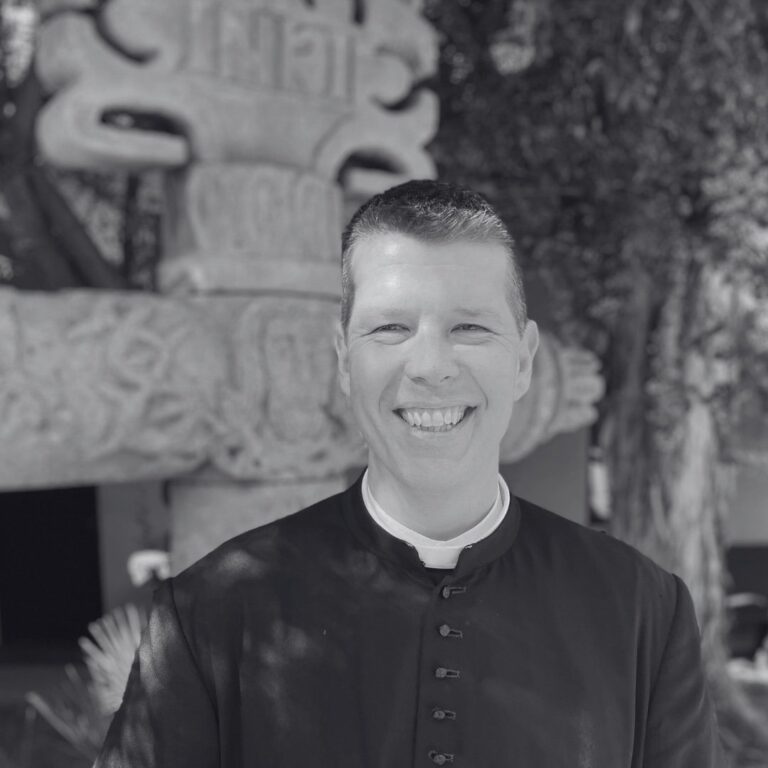
Fr Robert Hendrickson
Dear Friends in Christ,
GM Gilbert was the chief psychologist who interviewed Nazis on trial at Nuremberg.
He was looking for some common thread to explain the atrocities for which they were on trial. Indeed he was looking for some common thread that would explain the atrocities for which human nature itself seemed to be on trial. Horrors of an unimaginable cruelty paired with ruthless industrial efficiency made a mockery of the notion of human progress.
Here’s the answer he gives:
“I told you once that I was searching for the nature of evil. I think I’ve come close to defining it: a lack of empathy. It’s the one characteristic that connects all the defendants. A genuine incapacity to feel with their fellow man. Evil, I think, is the absence of empathy.”
Of all the trends in our current culture that I find truly alarming I think they find their root in this same evil, the absence of empathy. Compassion is literally the “co” suffering (passion) we experience with others, whether familiar or strangers, that is connected with empathy.
All of Christian charity and mission are knit together in empathy.
The ability to know the ache of hunger without being hungry, to know the fear of homelessness without being homeless, to grieve loss without being at loss oneself—the Christian work of caring for those whom Christ calls us to care for is predicated on our sense of unity with others in their sufferings.
The horrors of WWII were met with something, though. Across the English Channel and across the Atlantic those who could have simply stood aside as free people were conquered, subjugated, and exterminated realized that they could not simply stand aside.
Watching the dehumanization of others without acting would dehumanize them, too. To stand idle when we have the chance to relieve suffering is its own evil. The same lack of empathy that empowers the abuser also numbs the bystander.
This is the opportunity today, too.
Those lacking empathy, those caught in the brokenness of evil, will ultimately always fall under the weight of their self-interest and severed humanity. They will always be challenged by those who see the cost and, out of empathy, will let no one else pay it. This is the insurrection of hope that always runs counter to the world’s empathy-numbing cycles.
Our politics is now seemingly predicated on dehumanizing perceived opponents. Our culture is obsessed with grievances against this or that person, party, or sub-group. In all of this our empathy is being eroded to a narrow, petty self-interest that is actually the most destructive path we can be on as humans.
Our Christian duty requires a sense of empathy seen as Christ mourns for a lost Jerusalem, who grieves for the grief of the friends of Lazarus, who sits with those the rest of the culture were casting out.
And in perhaps the most profound act of empathy, Christ comes among us as one of us to share our sufferings.
And in an even greater act he unites us in his own Resurrection so that we may know that even death itself need not make us afraid.
He calls us to have the courage to be one with another, to share in one another’s sorrows, to bear one another’s burdens, and at the last to share in one another’s glory with Christ.
But first we are called to the most radical of challenges: to refuse to cease suffering for and with one another.
Yours in Christ,
—Fr Robert