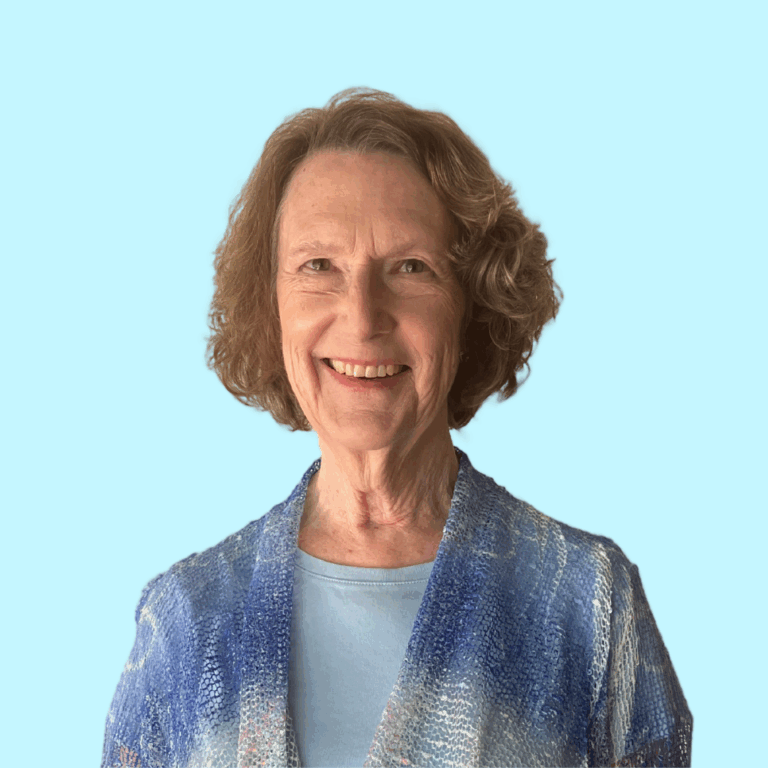
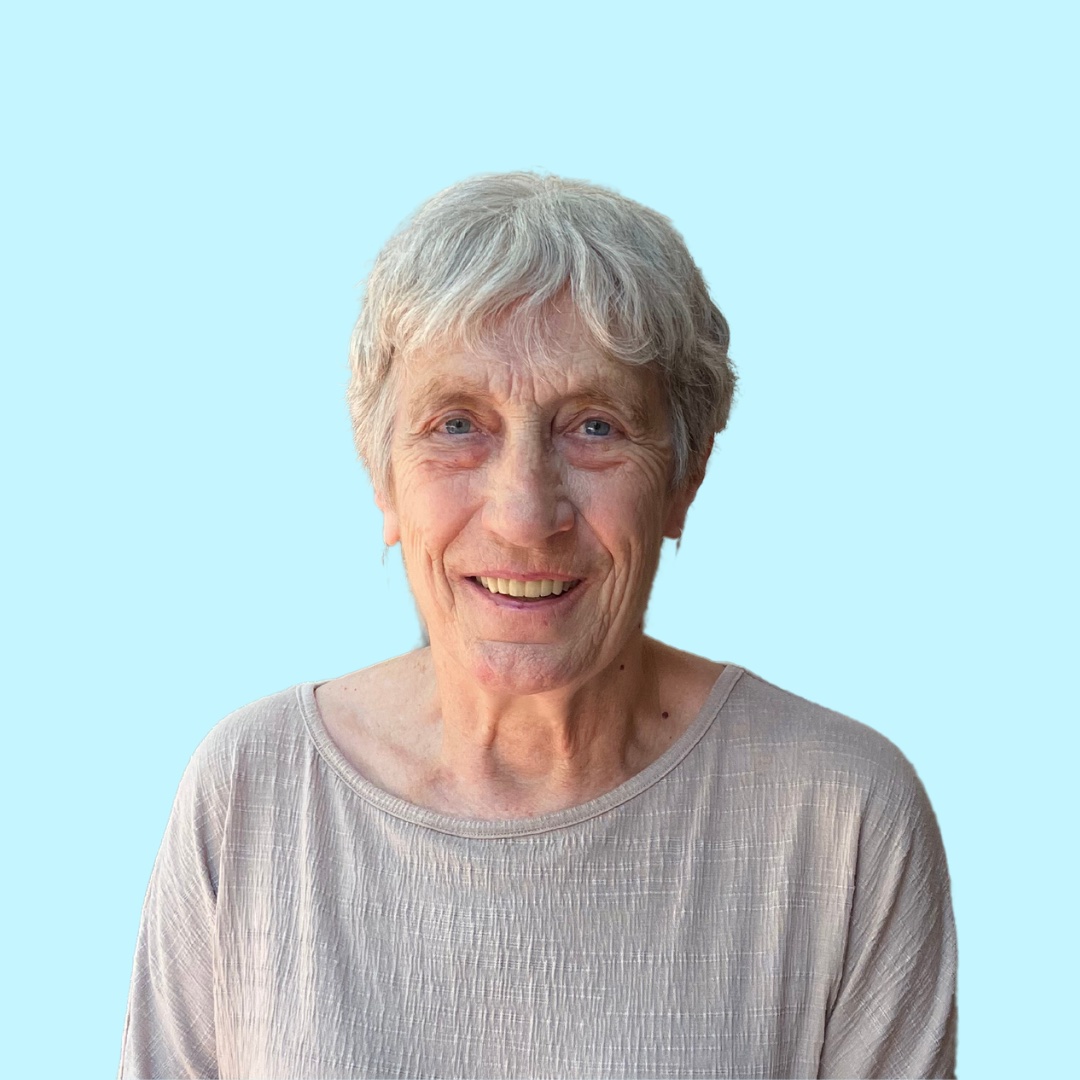
Julia Annas
How long have you worshiped at Saint Philip’s?
Since 1986. My husband, David, and I left jobs at Oxford in England to work at the University of Arizona.
Were you raised in a faith tradition?
Not at all. Our home wasn’t anti-religion but it was definitely secular.
How did you find your way to the Episcopal church?
My first introduction was at Oxford. The different services in the cathedral and various college chapels were very beautiful and meditative—especially Evensong.
What did you do professionally before retiring?
I was a professor of ancient philosophy and modern virtue ethics.
Can you offer some details?
Ancient philosophy covers 1,000 years and pretty much every philosophical position. I taught and published over quite a wide range but in the second half of my career I specialized in ancient ethics. There’s a large cross-fertilization between ancient and modern ethics so working on each helped with the other.
What’s the difference between ancient and modern ethics?
Quite a lot. But for the sake of brevity, I’ll over simplify the comparisons:
Ancient ethics is very much about virtue and character. For example, it poses that ethics is a well-lived life. In modern ethics, there are three main schools of thought:
One asks what will produce the greatest benefit for the greatest number of people; another considers what rule or principal ought one to follow (regardless of the consequences), and the third looks at relevant virtues while being sensitive to relative difficulties. This last one is most similar to ancient ethics.
A lot of philosophers think one can’t be a serious philosopher and a Christian. They believe that one has to make a choice.
How do you navigate the two worlds?
By being in community. I’m nourished by attending services, participating in classes, and maintaining my friendships here. All those things keep me going emotionally and keep my faith alive.
I love reading our Greek Fathers’ writings but that’s not what keeps me faithful.
How are you involved in the parish?
I’m currently on the Vestry, am Co-Chair (with Kelsi Vanada) of the Adult Formation Commission, and serve on the Sacred Arts Committee. I also participate in the Tuesday morning Bible Study and join the Literati Book Club at 7:30pm on the second Monday of the month.
And on many a Sunday I serve at the altar as a subdeacon. The liturgy is the center of church for me, and I appreciate being near the altar.
I used to be on the Murphey Gallery Art Committee and led forums on a wide variety of topics.
What makes you feel like you belong to this community?
Practically speaking, my length of time here. Fr Robert is my third rector.
But equally important is that Saint Philip’s is an open-minded community; it’s a very comfortable place to be. I don’t have to believe a certain number of things or worship in a certain way. Those attributes have always been at the heart of this parish regardless of who is Rector.
And then, of course, the moment I stepped into the church I thought, “Wow! It’s incredibly beautiful.” Plus, there’s the refined liturgy and inspiring music.
You’re a two-time cancer survivor. What role did your faith play in those experiences?
It made a huge difference. Being in community—at two levels.
First, there was the church itself and the people here. I didn’t attend services in person during my chemo treatment but I watched via live-stream. And the Fiber Guild ladies knitted me a fabulous pink shawl for the chemo room. That was wonderful.
But I’ve also always felt that community in the church is being in communion with all the faithful—dead, living, and to come. Reading the service or some church text helps keep me part of the church. That was especially important to me when I still worked.
Can you explain that?
David was always a member of the choir but I got really involved only after retiring. As an academic, I was always under great pressure to produce—with little time to do that—so belonging to the community of all the faithful was very meaningful to me. I felt a part of the church even when I couldn’t be on campus or participate here as much I wanted to.
What do you do to relax and replenish yourself?
I hoover up books! I read philosophy and books about art. I also enjoy reading about things I don’t know much about. And I try to read Italian. That’s a slow process.
I can read French, German, and Italian pretty easily if the subject is an academic article (because I know what it’s about). But if I read a newspaper article, it’s much more challenging.
You’ve traveled a good deal. Where would you still like to explore?
I’d like to see more of central Europe.
What’s something you’re proud of?
I’m proud of our daughter and how she’s turned out. She’s married and I admire the values she and her husband have.
What’s something you’re passionate about?
Inquiry. I’ve always been curious—especially about people and ideas.
What’s one of your core values?
Honesty—both professionally and personally.
Professionally, it was important to be honest about what part of my ideas I owed to other people. And personally, to be honest in conversations with people who I might care about but disagree with.
What’s one of your guiding principles?
Fairness. Students don’t all arrive at university from the same place. For some, philosophy was an entirely new subject. For others (who might have studied psychology) it was more familiar.
During my more than 40 years of teaching, I worked hard to navigate the tension between being fair to individual students while also being fair to the entire class.
What’s something you’re grateful for?
My husband and my daughter. But beyond them, I’m grateful for the chances I’ve had in life that many others haven’t. I’ve always loved my jobs and I know that’s not the case for many.
I’m a first generation university student. I was able to go to Oxford because I went at time when I didn’t have to pay. That was very lucky. And I was fortunate to be able to leave Oxford and grow in my profession. That’s also unusual.
What’s one of your super powers?
Curiosity! I’m 78 years old and still curious. Of course, another way to say that is that I’m bored easily.
What’s something you’d like to do that you haven’t yet?
I would love to learn Japanese. Partly because I’d like to visit Japan again, but also because my sense of the country is that it’s so elegant and refined. I know it’s also the country of, “Hello, Kitty,” but the culture has always intrigued me. For instance, the way art merges with the calligraphy fascinates me.
What’s something about yourself that might surprise people reading this?
I don’t know if this will surprise people but I’m still working on private prayer. It’s been years and I’m still working on it. It might be different for someone brought up in the church but I find it difficult; it’s not a natural thing for me. Progress has been slow but it is getting easier.
Do you have a favorite proscribed prayer?
The prayer after Eucharist: Almighty and everliving God…send us out to do the work you have given us to do, to love and serve you as faithful witnesses of Christ our Lord…. Being sent out to do the things we have been given to do—what a wonderful thing to keep in mind.
What’s a fun fact about you?
I love cats. David and I are grieving our most recent loss.
They’re just beautiful and, because I love to look at them, I spend far too much time watching them on Facebook.
Biologists say cats are perfect. All cats, wild and tame, don’t just look similar—they are similar. They don’t need to adapt because they’re perfect.